Categories
Data Visualization

“What care I for words?”: Visualizing Characters’ Speech in As You Like It

Date: Winter 2021

View this project here

In this project, I studied characters’ speech patterns in Shakespeare’s As You Like It. I hand-annotated the play for who talks to whom and then designed and coded a visualization that is meant to facilitate an explorative analysis these speech patterns. This project was the first time I created a visualization intended to facilitate literary analysis and it served as the starting point for my English senior thesis project.

Categories
Data Visualization

Biodiversity in National Parks Visualization

Date: Winter 2021

Partner(s): Shannon Liu

View this project here

This interactive visualization allows for the exploration and comparison of biodiversity data in coastal and inland national parks. We designed the visualization from scratch for this particular dataset and used the D3 library in Javascript to implement the visualization in Observable. We facilitated several forms of interaction to help users with their exploration. This project allowed me to gain further experience designing visualizations that prompt users to explore answers to a particular question.

Categories
Data Visualization

Most Common Baby Names in the US Over Time Visualization

Date: Winter 2021

Partner(s): Shannon Liu and Maddie Kyhl

View this project here

This project prompted my partners and I to critique and then redesign an existing visualization. The visualization displayed data on the popularity of baby names throughout US history. This was the first large-scale project I undertook in the interactive notebook tool Observable using the D3 library in JavaScript, a tool I have frequently used since. It was also one of my first experiences thinking about what the affordances of digital visualizations are and how best to facilitate user exploration of a particular dataset. Additionally, this was the first time I was involved in designing an interactive visualization.

Categories
Data Visualization

Reading Abstracted: Visualizing Routines

Date: Winter 2021

View this project here

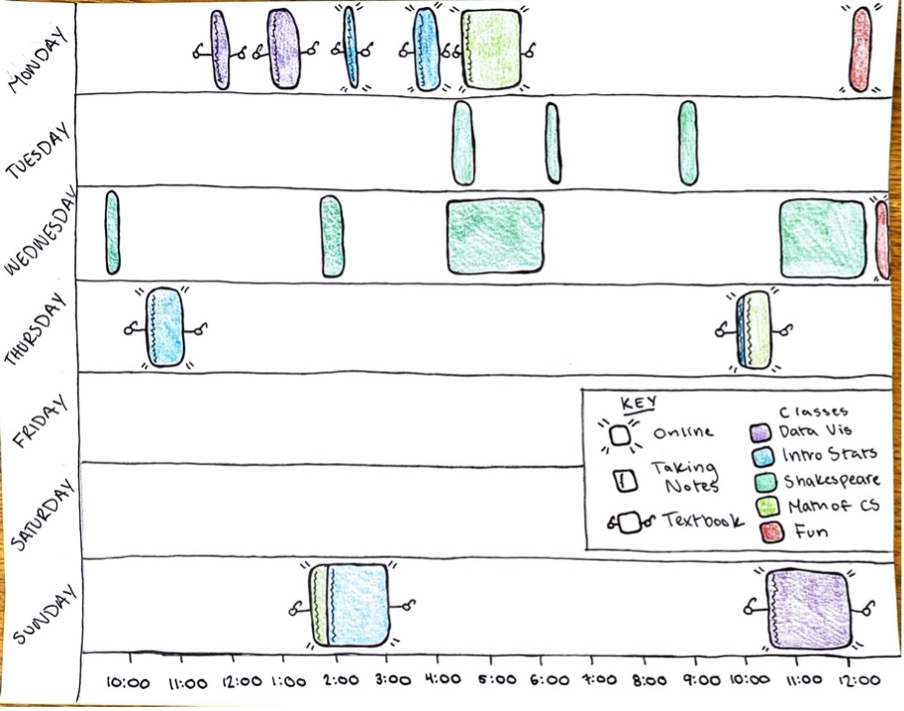
This essay describes a visualization I designed and hand-drew. The visualization depicts data I collected on my own reading habits over the course of a week. This project, inspired by the Dear Data project created by Stefanie Posavec and Giorgia Lupi, was my introduction to designing specialized visualizations for specific datasets, a concept that has been central to much of my DH work since.

Categories
Data Visualization

Word Clouds in the Wild

Date: Summer 2020 – present

Partner(s): Maanya Goenka

The broad goal of this project is to determine how word clouds are being used in various arenas such as digital humanities and journalism, with the eventual goal of creating visually pleasing but effective word clouds. Along with Professor Eric Alexander and Maanya, I used grounded theory (a method of qualitative data analysis that involves hypothesis formation through data collection) to study word cloud usage in digital humanities academia and journalism. I then analyzed the collected data. This is the first long-term research project I have been involved in, and we are currently writing up the results of our survey for publication.

Categories
Data Visualization

Co-Taught Class Network

Date: Winter 2019

Partner(s): Nicole Connell and Brooke McKelvey

For this project, my partners and I hand-processed old Carleton course catalogs to determine which professors in which departments frequently co-teach classes. We then input this data to the network creation software Gephi to visualize which professors and which departments have most frequently co-taught classes in the past and which departments often co-teach classes with each other. This was one of my first experiences with processing large amounts of text data, a trend that’s continued throughout much of my digital humanities work.

Categories
Media Generation

Carleton Course Assistant

Date: Spring 2021

Partner(s): Theresa Chen, Alistair Pattison, and Logan Peters

View the code associated with this project

This project is a chatbot that prompts users to enter their favorite courses and then uses natural language processing techniques to compare course descriptions and suggest the most similar courses to the user’s favorites. It also uses NLP techniques to create an imaginary class to recommend. This project required my teammates and I to combine many NLP techniques into a cohesive project. It is the second chatbot we created as a term, and in it we attempted to create a different sort of interactive experience.

Categories
Media Generation

Murder at the Sherwood Forest Fair

Date: Spring 2021

Partner(s): Theresa Chen, Alistair Pattison, and Logan Peters

View the code associated with this project

For this project, my teammates and I created a dialogue system that prompts the user, who is acting as a detective, to solve a murder. It uses several natural language processing techniques to construct a unique mystery each time it is run and allow the user to conduct interviews as they search for the murderer. The bot was intended to bring users into a unique world and storyline each time they interacted with it, creating a novel experience every time. Throughout this project my teammates and I learned to write a complicated chatbot that integrated multiple NLP techniques and how to create a flexible narrative within the constraints of a computational setting.

Categories
Media Generation

Generating Poetry Pamphlets with Procedural Rules

Date: Fall 2020

View the code associated with this project – and a sample output

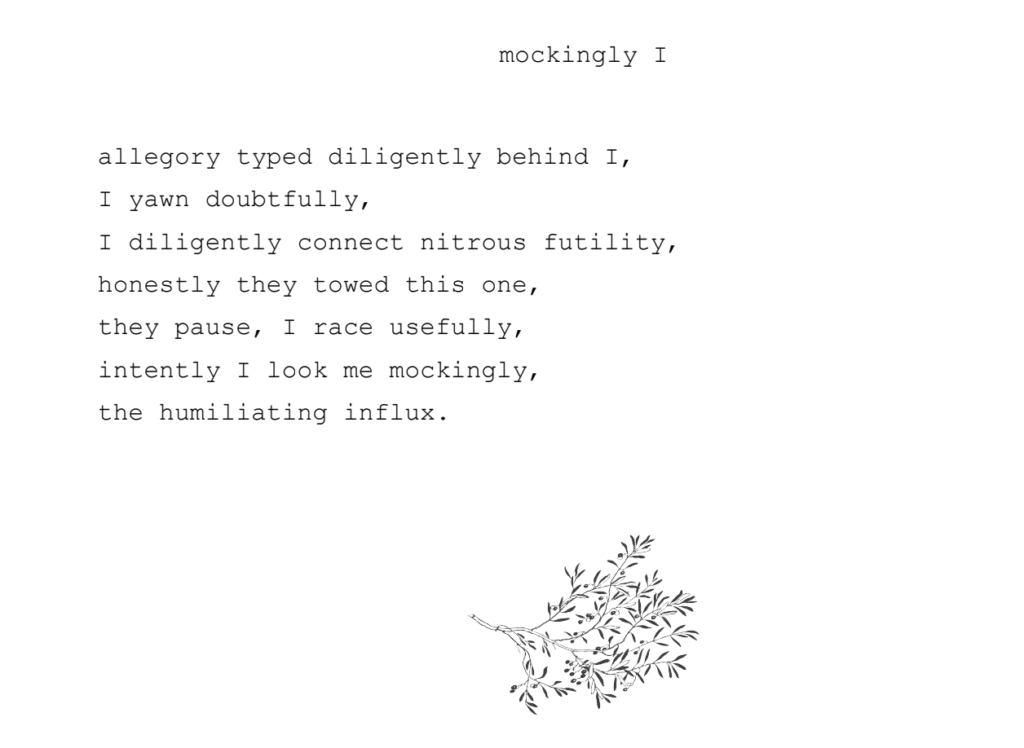
In this project, I used a grammar parser and rule system designed by Professor James Ryan to create a pamphlet of sonnets and free verse poems. I wrote rules for creating technically correct sonnets and less structured free verse poems from a corpus of words separated by part of speech and number of syllables. The PDF generator also uses a logic system to include an image with each poem. This is the only large project I have created that uses computational techniques to generate creative textual output. It combined words and phrases in unique ways that I would never have myself because of linguistic conventions that I have been taught since birth. However, once the program generated these unusual word combinations human creativity can find meaning in them.

Categories
Media Generation

Generating Dance Routines with a Procedural Grammar

Date: Fall 2020

View the code associated with this project – and a routine performed

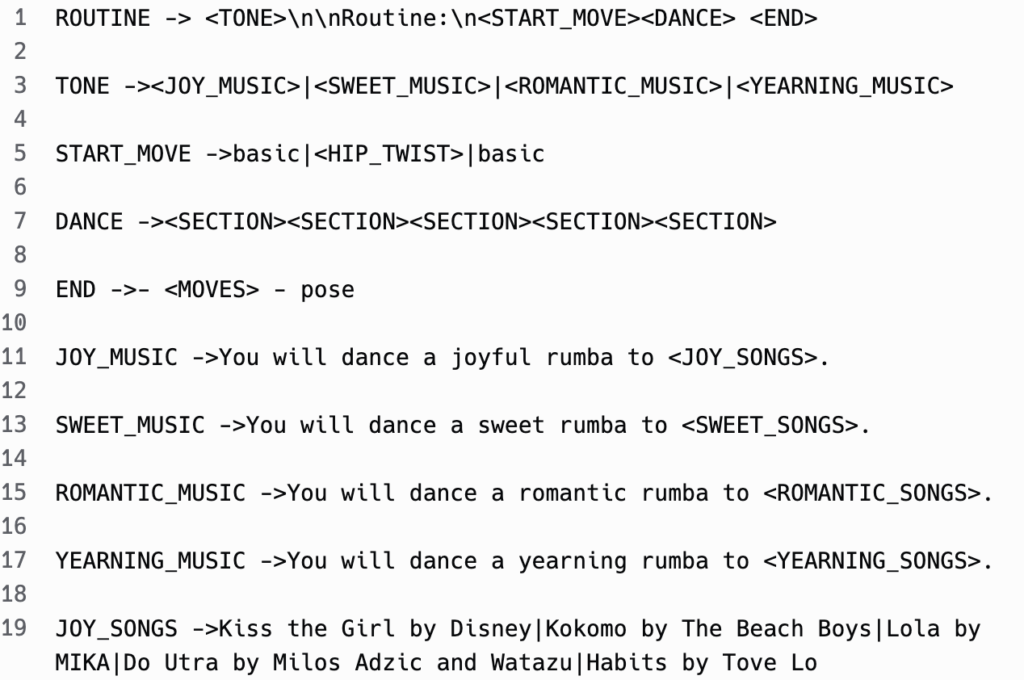
For this project, I used a grammar system written by Professor James Ryan to procedurally generate International Rumba dance routines. The system ensures that the sequences of movements produced will be danceable and also determines what song the routine should be danced to and what the atmosphere of the performance should be. I performed an output of the system over Zoom with my dance partner, Stuart Kraabel. This program encouraged me to leave my comfort zone because it produced routines I would not have choreographed myself and dictated unusual styling choices that forced me to reconsider performance norms that were ingrained in me.

css.php